Tuesday, December 13, 2011

For the Love of Horses


When I was nine or ten, my parents bought me my first horse. Actually, he was a large pony from Old MacDonald’s Farm, a local petting zoo. I have no idea why the farm was selling him, except he liked to bite. He was black and white, with a thick neck and big head. I thought he was beautiful. My own pony. I had dreamed about this day for years; well, at least since I was eight.

As I remember, that first summer was a bit rough. Perky (a name that never quite fit the package) had the bad habit of bucking me off on a regular basis. We eventually reached an understanding, but I had many friends who ended up in the dirt of the arena at one time or another. It was a right of passage. No one rides the pony without hitting the dust a few times for good measure. Luckily, this was in the 1960s when no one talked about suing anybody.

Perky died when I was thirteen. My parents replaced him with another horse and I continued riding through high school. A bit like the Velveteen Rabbit, I lost interest in my college years and the ponies were sold. The stable became a shed for garden tools; the fencing of the paddock a trellis for the wild roses my mother planted to border the lawn.

There weren’t horses in my own back yard again until more than 20 years later. Up to that point we had had neither the space nor the money to host animals larger than a dog, a cat, an iguana, various domestic rodents, and a bird or two.

The ponies arrived as rescues in the night and thus began a new chapter for the horses in my life; except this time I had daughters of my own and a husband who had spent more childhood years riding a dirt bike than anything with four legs and a mane.

The idea was to teach our girls to ride, to be responsible for something larger than a dog, and to keep them distracted through their high school years when sometimes a horse can be a better friend than the two-legged kind. It didn’t work exactly like that for both kids because apparently you have to have some special crazy-about-horses girl gene to make you keep riding when your friends have other ideas to occupy the hours after school.

But all of us were touched in one way or another by the horses in our back yard. They morphed over time as some proved more reliable than others, but we settled on one of our rescues, Moralecia, a fancy little Arabian with a large attitude and a good mind, and a square-headed Appaloosa named Chaco who was athletic and gentle in an old soul kind of way.

Our horses became ‘familiars’ as the years passed and our girls grew. There is a strange, almost centaurian oneness that develops from riding a horse day after day, where communication is handled by the shift of one’s weight or the nudge of a heel. It’s non-verbal but totally understandable. Our horses in turn used their own signals, if we were smart enough to pay attention: the turn of an ear, a look in the eyes, a nuzzle, a shove.

In the end, if you want to know the truth, I think we can actually blame our move to this farm on the horses. Greg figured they needed more space than our 1-acre suburban lot and so he bought them 40! I never understood until then that for the love of horses we were to become farmers.

Old MacDonald’s Farm was a prescient look into my future. No petting zoo here and the horses don’t bite, but Perky would have loved this place. And, while it took our desert horses more than a little time to adjust to the green pastures and forests of Oregon, they’ve settled in. So, too, have we.


Photos:(top)Moralecia and Chaco when we first arrived in Oregon;(bottom)Moralecia, Chaco, and Tater about 3 years into our move

Postscript. I have been remiss at finishing any of the blogs I started since last May and have about 10 partially completed, but none ready to 'go'. As I find time this winter, you may read stories from 6 months ago and wonder what is going on at the farm. Nothing, except it's a farm and farming is never done.

All rights reserved. Copyright 2011 Scottie Jones

...Click here to read the rest of this post.

Monday, May 23, 2011

Nona and Deedee


Nona and Deedee started life just as their mother lost hers. I don't know if it was Nona or Deedee that I first swung upside down, back and forth, to get the fluid out of her lungs and her breathing started. Which ever lamb it was, she hasn't held it against me. Both lambs were rubbed down and in a cardboard box with straw, placed in front of the wood stove, before they were even 15 minutes old.

By the time the girls were a few days old, living in the house with the dog and the cat had become customary and normal. They were given access to all the rooms during the day as long as they had on their disposable diapers. We cut a hole for the tail and, being girls, the system worked sufficiently well. At other times, Deedee and Nona were relegated to their cardboard box for lamb control.

The dog was interested in the babies. The cat wasn't so sure. Cisco would clean Nona's and Deedee's wool and lick them all over, especially when they dripped milk down their chins and around their mouths. Similar to the ministrations of a mother ewe, this encouraged them to drink more and suck harder on the nipple of the bottle. It also helped to keep their faces from getting crusty with old formula. Shortly, the lambs learned to climb out of the box and were thus sent back to live a lamb's true life at the barn.

Deedee and Nona were named for ancient Greek goddesses or furies or something. Annie might be a vet student but her semester of Greek archaeology had proven interesting to her and thus influential in her approach to naming these babies. She did, after all, deserve first rights for delivering them. She picked names that reflected the goddesses who oversaw childbirth and fertility.

It seemed fitting but I had the hardest time remembering the names to start. Usually I let lambs name themselves. If it had been up to me, the lambs would have called themselves Laverne (Deedee) and Shirley (Nona). It was that obvious in their personalities.

So, here we are now, with lambs a month old intermingled with all the other lambs on the farm. Instead of being afraid of us, they push to the front of the flock and dive through the barn door at feeding for a bottle of formula and a scratch on the head. This has all been to the extreme delight of guests and their children. Who can't love the smell of a baby lamb; feel the soft wool; oooh and aaah as they tangle around your legs pushing up for a bottle of milk? Like all babies, they are picked up and carried around. They are posed for photos. They are treated like pet dogs.

On a warm day when the doors are left open, it comes as no surprise to find them walking into the house, especially when the sheep are grazing the orchard close by. Our split rail fencing works for sheep but not so well for lambs. It's an easy squeeze for Deedee and Nona, and they sagely know how to find the front door.

Without diapers, the lambs are not as welcome in the house. The cat is still wary and will run sit on the stairs. The carpet may be old, but lambs peeing on it are not appreciated. I wave my arms and scold until Deedee and Nona bounce out nonchalantly. "Who's she yelling at? Us???" The lambs graze the lawn. Sometimes they check out the guests and totter up the steps onto the deck. When it suits their purpose, Deedee and Nona will squeeze back into the orchard to play with their kindergarten class.

I suppose I should just be happy they haven't figured out how to use the dog door, although I did see them watching Cisco pass through it the other day. Quite intently, I might add.

Photos: (top) guest with Deedee and Nona on the bridge; (bottom) guest feeding Deedee. Photos by C. Anderson (father).

All Rights Reserved. Copyright 2011 Scottie Jones

...Click here to read the rest of this post.

Tuesday, May 03, 2011

The Farm Kitchen

The farmer's kitchen. A place of warmth all year 'round when we used to cook on wood stoves. Still a place of warmth at meal time, but there are so many other parts to it, and it's not all about food. It's about the workings of the farm and the place where everything is brought: to be cleaned, to be cared for, to be stored, to be dried, to be warmed, to be processed. Doesn't sound like your kitchen?

What's in your dish drainer? I bet you don't have a drench gun for wormer and rings for canning jars next to the baby spoon! Of course, when I look up from the sink to the window ledge, I see the injection syringes drying next to the potted plant, the dried poppy heads now devoid of their seeds, and my sheep collection given to me largely by friends in support of our farm name, Leaping Lamb Farm.

Turning around I survey the 'animal rescue' area of the kitchen. There is a turkey sequestered in a cardboard box in the window bay and a chicken in a cage, both with heat lamps over them. I checked with another farmer. "Where do you keep your chicks, your bummer lambs, your injured animals when they are in need of attention?" The basement. Hmmm, we don't have a basement, but I know other farmers who use their kitchen just as we do and sometimes even for baby calves. I find the linoleum floor makes it easier to clean and the location (not at the barn) makes it easier to creep down in the middle of the night to feed the baby lambs their bottle of milk warmed in the microwave overhead.

It seems expected that there would be dried oregano, with its purple flowers, and sage and mint tied in bunches hanging from nails pounded into the wood beams of the ceiling and wood posts exposed in the walls. Then there is the colorful feed corn hung everywhere there is a nail, to dry with the heat from the wood stove when it is first shucked. And at some point these things become ornamental and no longer visible except when needed for cooking or to the guest passing through a room.

There's more. Jars of dried chilies rest on the counter when there is no room left in the pantry. These sit a-top the cheese kit waiting for the time when the neighbor's goats have kids and we can try our hand at making goat cheese from the nanny's milk. The orange press waits for oranges that our move to Oregon can't promise, at least not from our own trees. It adds a farm kitchen touch all its own, partly because it's ancient, and partly because it stirs memories of my grandfather's kitchen that was always warm and always promised fresh-squeezed orange juice from this very press.

All the implements of a farming life and more reside side by side as if there were no purpose other than to be handy. The needles, the tools, the implements, the artwork - they all tell a story of life on the farm. With all this warmth and goodness, I wonder whatever possessed the writer of the song about the three blind mice, the farmer's wife, and her carving knife...that was likely kept in the kitchen. On reflection, that is one weird song and stories about the mice in our kitchen are best saved for another time.


Photos: (top) above the sink; (middle) orange juicer; (bottom) family photos mixed with sheep

All rights reserved. Copyright 2011 Scottie Jones

...Click here to read the rest of this post.

Wednesday, April 27, 2011

Farewell to Fred and To Be A Vet Part II


As if lambing season isn't enough to deal with in the spring, our larger feathered friends and livestock took a hit in April. Turns out everyone in the woods is hungry by the time winter is retreating and raccoons are not dissuaded by the size of a bird, be it a peacock or a turkey.

The first casualty was Fred, our magnificent 20 year old peacock (sure, not a turkey, but he needs to be mentioned). Fred was our masthead, our showy bird, a photographer's dream, and a beggar when it came to crackers on the deck during a summer happy hour with friends. He was also a favorite of our guests and many a child drew pictures of him and left us notes about their new found friend. As a beggar, the bird had learned that the best handouts derived from folks who came and went and who delighted in the fact that he would roost right outside the cabin living room, peeking in the window for dinners and games of cards.

We suspected nothing to start. Heck, Fred had been posing on the back deck just the day before, but it seemed odd that he wasn't around that next morning for breakfast with the chickens. Odd enough that I decided to walk up toward the cabin to see if he was only being lazy and still astride the railing roost. From afar, I could see a mound of feathers on the ground. My heart sank because I knew the rest.

It's hard to go from a gorgeous bird to a carcass, but that's all that was left. A tail feather here and there across the lawn. The breeze kicked up some beautiful iridescent blue green pin feathers and that was all that remained of Fred. I picked them up and stuck them in the fence. A farm memorial.

Life goes on at a farm and we chalked up Fred's untimely demise to a bold raccoon. Our next victim was only days later. One of our turkey hens had decided to sit on a nest outside of the tight chicken wire of our coop. We had moved nests before and never been able to get the birds to sit again so we decided to leave her be.

When we entered the chicken yard the bird looked odd, bedraggled, dirty. She staggered. The nest was demolished and all the eggs gone or broken. As I picked her up for a better look I realized she had lost most of her feathers under her wings, there were flaps of skin hanging loose, and she had a big gouge out of her back.

Time for vet-in-training Annie to do what she could.

"I don't know anything about birds," she said. We called the local wildlife rescue for a primer on bird doctoring.

A quick trip down to the store for bandages of all kinds and a rifle through the human medical supplies for antibacterial ointment and then the bird was scooped up and placed on the dining table, for lack of anything else at the right height and with the right amount of light.

Even for Annie, who will perform a necropsy just to figure out what went wrong with an animal, it was a pretty gross job. For me, it was downright disgusting as we first cleaned then medicated the areas that had been ripped by sharp raccoon nails and teeth. The bird wasn't all that happy either, especially when we fashioned a holding area for her in the kitchen with straw as the flooring and a heat lamp to keep her warm and dry.

Luckily for the hen, after a few days she seemed recovered enough to return to the chicken yard. Plus, the smell always tells us when its time for the animals to depart our living quarters. Sure, there was dirt in the chicken yard and birds are not kind to the down-trodden, but the turkey seemed more at ease with some space around her and not our household domestic goings, especially at meal time when undoubtedly we were eating a cousin or some other brethren.

For Annie, it was another notch on her belt of things she could add to her laundry list of farm experiences. Maybe useful in vet school. Maybe not. For the farm, it was a lesson in predators and the fragility of beautiful life. It's all about the circle that won't stop, no matter how resplendent the victim.


Photos: All of Fred. Doctoring of turkey was too gross.

All Rights Reserved. Copyright 2011 Scottie Jones

...Click here to read the rest of this post.

Tuesday, April 12, 2011

To Be A Vet

For most of us who raise lambs for market and not for show, vets are not part of our landscape, even when things go wrong. An average ewe sells for about $50. A vet visit to the farm starts at $125. It's hard math at the end of the day, but sometimes it's a hard decision. This past weekend was just hard.

We like to cull our ewes (sell them) when they birth small lambs, but culling older ewes is hard when every year they keep producing healthy, strong twins and triplets. There are also ewes that I just like. Because they are friendly. Because they don't knock me over. Because they are good mothers and have a kind eye.

There is a reason to cull your older stock and this sounds cruel, but maybe we were cruel in our own naive way. This year we experienced something you hear about with pregnant women: pregnancy toxemia. It's when the body just can't keep up with the nutrients required by the fetus. In this case, one of our favorite ewes went down with large lambs, and twins at that.

We noticed her down in the paddock and unable or unwilling to get up. At first I thought she must be delivering her lambs but after several hours and still no sign, it appeared there was something horribly wrong.

Shepherd Annie started to get out the books and then, as all 20-somethings do, started to look online for a cause. She came up with a myriad of diagnoses, but the one that really seemed to stick was the toxemia. She returned from work that evening with bottles of this and drips of that and we went to work trying to keep the ewe comfortable out in the pasture, the sky threatening rain.

We dosed her and watched her. I put up a tent over her. Several days later she started to eat. Yeah! We got her to her feet and walked her up the hill and into the barn on unsteady legs and with lots of coaxing, but at least there was clean straw and the safety of an enclosed stall.

Except as this was unfolding, we noticed another ewe down. The symptoms seemed similar, but the dosing made no difference. We carried her into the barn, except we only got her just inside the door. We were losing her.

I ran back to the house for the phone to call our neighbor, Dr. Liz, who was currently on the other side of the country. Our bad luck. When I reached her, I asked,

"Do you think Annie can do a c-section?"

"Sure she can. She's up to it."

I put Annie on the phone for instructions. When Liz was finished telling her what to look for and how to proceed, we returned to the barn. Annie had found her scalpels which she kept on hand for necropsies.

I actually thought we were too late, but miracle of miracles, Annie delivered two healthy ewe lambs: one for me to swing in the air until her lungs were cleared and the other that Annie did the same for. We rubbed them down with towels and quickly put them both under a heat lamp.

Our vet-in-training (aka shepherdess) was getting more experience than most before actually going to vet school. We couldn't have saved the babies without her. Of course, the sad part was that our vet-in-training didn't know how to sew the mom back up, although we doubt she would have survived anyway. Instead, we had to euthanize her. Two lives in exchange for the mother's. Damn.

Did I mention we had neighbors over for Happy Hour that night? We returned back to the house with two bundles that we placed in a cardboard box near the wood stove. It was oooing and aaaahing time and then the babies fell asleep. We settled in for a glass of wine as the adrenaline kicked back and the reality of what had happened filled the evening conversation.

Photos: lambs in a cardboard box near the wood stove

All Rights Reserved. Copyright 2011 Scottie Jones

...Click here to read the rest of this post.

Tuesday, April 05, 2011

March Went Out with Lambs


March may or may not have come in like a lion but it went out with lambs. I mean, we had lambs everywhere and mostly over just one weekend. On April Fool's Day, the joke on us was whether we could be sure who's lambs were who's because we hadn't had a chance to tag in two days and there seemed to be babies everywhere!

We have white lambs and black lambs and brown lambs and spotted lambs. We have twins and singles and even a set of triplets. But we usually lose a lamb or two as well. It seems the ewes know which to suckle and which to leave, and though we may intervene at times, nature often has her way. I love this time of year and I hate this time of year. Even my guests will nod their heads with understanding. Farm life is about life and death and the circle it forms.

It's not that city life is really that different, or suburban life, or any place you go. It's just that the circle is so close to your face on a farm. We have livestock and any breeding season with more than a couple animals means there are chances for things to go terribly right and terribly wrong.


Lucky for us, most of the time things go well and we have bouncing baby lambs all over the place. Lucky for us, this is the time of year that guests love to visit to be a part of it all. We need the extra hands and eyes just to catch the little darlings and to make sure that everything is going okay.

So, this weekend, the tagging and docking is on. We will have to hope that the babies we pick up for their shots will call to their moms and we can straighten out who belongs to whom. I thought I had it figured out at the beginning, but once they are all in the jug for a few days and start mingling and playing (yes, they play as early as Day Two), things get complicated!

We will have to rely on Shepherd Annie who is keeping a sharp eye on the flock for her records. She's off to a good start this season with decent weights on the young'uns, and healthy too. Hopefully, she will be able to sort it all out. If not, the ewes will!

Photos: Ewes and their lambs...all over the place

All Rights Reserved. Copyright 2011 Scottie Jones

...Click here to read the rest of this post.

Wednesday, March 16, 2011

Oops Lambs


I'm a little late with the news, but then, the lambs were early and they were a surprise.

I suppose I should know by now that, if we are in a hurry, something unexpected will likely upset a typical morning routine like feeding. This particular morning Annie was getting ready for a vet school interview and we had left time to go over hypothetical questions and practice answers. Wishing to get started, Annie offered to help me feed the sheep and horses.

I ran up to the hayloft to throw down bales of hay. Annie proceeded to the back of the barn for a overview of the loafing shed. I heard her call from down below and stuck my head over the drop chute.

"What did you say?"

"Lambs," she said.

"What do you mean by 'lambs'?" I said.

"We have lambs!"

No, I must have heard her wrong. The rams had not been placed in with the ewes until October and, with a five month gestation, we weren't expecting lambs until the end of March. It was mid-February. Only the shepherds in the valley had lambs this early in the season. It was still cold, snowy, and rainy and not a good time to be having lambs in the Coast Range.

I trotted back downstairs and walked to the back of the barn. I followed Annie's gaze over to the two small brown lambs lying next to their mother. They looked healthy, but our protocol for new lambs was to bring them into the barn for several days with their mom just to give everyone a positive start on life.

I looked at our lambing stall and realized it needed a clean bed of hay. We needed water for the mom and a working heat lamp for the babies. We were definitely not ready with tags and shots and all the other tools of our trade. Damn. Surprised again and all on a day when there was a pressing vet school interview to deal with!

Although she had just showered in anticipation of her interview, Annie jumped down and grabbed a lamb as I grabbed the second one. We walked them into the barn with the mom close behind. Installed in the stall, mom and babies looked healthy enough.

This was one of our older, experienced ewes, and apparently a hussy at that! When could the tryst have happened? Annie reminded me of the gate knockdown in September that allowed the rams access to the ewes for about two hours. Two hours?! That was all it took for this ewe to get knocked up?

I could hear Annie sighing as once again her records were going to be incomplete for the year. "Who's your daddy?" was starting to be a familiar tune at Leaping Lamb Farm! Their brown coloring probably meant Red's babies, but long ears were a give away for Duke. We would have to see how they grew.

Back in the house we practiced mind-numbing questions like, "Why do you want to be a vet?" and "Why should we pick you over anyone else?" Annie dressed and left for her interview. She had already been accepted to another school so she should have been calm, but nerves were in the air and the lambs had been a distraction.

I understand the interview started with the story of the wayward ewe. Imagine vets all around, nodding their heads, remembering other lambing stories with surprised owners, surprised lambs, surprised ewes. "That's sheep for you," said one. And the interview went downhill from there.


Photos: (top) twins; (bottom) mother looking over her babies

All Rights Reserved. Copyright 2011 Scottie Jones

...Click here to read the rest of this post.

Thursday, February 24, 2011

All the Sheep Were Lost


In the summer when the grass has dried and gone brown, we have had cases of disappearing sheep because our fields are not fenced against the mountain. So, it was with some surprise to realize we had lost sheep on this winter day.

When I went to feed in the early evening it appeared only half the herd had shown up at the barn. There's a regular routine of fields to rotate through, back to the barn for a siesta, more fields to graze in the afternoon, then back for a dinner of last summer's hay and a quiet, safe bed-down for the night.

It's called a routine for a reason. There are certain expectations for all concerned. Today only half the sheep seemed to remember my concerns: predators in the woods versus a restful night's sleep for the shepherdess. Okay, and I had also left feeding until later than usual!

With the daylight of spring still far off, dusk was rushing in and, by my count, we were missing 18 ewes, all of them pregnant. Do the math and we could be talking an additional 30 potential lambs. As I stomped from field to field whistling, clapping my hands, and grumbling under my breath, I saw no sign of moving bodies, even bodies bedded down for the night. The sun seemed to drop precipitously behind the mountains and our valley was full of shadows.

I walked from the end of our lowest field clear up through the underbrush to our neighbor's property and then farther to the next. No sounds, no movement, no flashlight. I returned to the house for one and solicited our daughter, Annie's, help. She took off in her car in one direction. Our neighbors, who had now been called to be on the look-out, hopped into their truck to check out some of the logging roads at the back of our properties. This is where country neighbors really rock and neighbors who know the back roads are the best!

Since walking up in our woods can get a little scary in the dark, and Greg had just returned home from work, he offered to change and come out with me. Had I checked up the hill in the clear cut? Well, I had made it up part-way but turned back figuring they wouldn't have gone that far. Hmmm, Greg was not convinced and started up the Mule so we could drive. Forget the hiking. This was taking too long.

We four-wheeled it to a fallen tree. We looked with flashlights. We whistled. We started hiking up the hill. I went ahead and then turned back. But, "Had I checked in the clear-cut?"

"Well, not exactly."

I turned around with Greg behind me as we tripped over fallen branches and squeezed around road blocks. As we shined our flashlights up the hill, all of a sudden there were dozens of eyes reflected in the light. A herd of deer? A large band of raccoons? Something more sinister - weren't cougars loners? The mind goes wild in dark woods. Was this our missing band of sheep?

The dog took off after them, pushing them up the hill away from us instead of back down to the trail. I yelled before we lost the sheep again. Thus began a tripping, falling, scramble to move the sheep through the woods, over the dead fall, and back to the barn.

At one point the flock divided into two groups. We yelled. We clapped our hands. We hoped the groups had figured out how to join-up, but sheep in the night are worse than sheep in the day - unpredictably dull-witted.

We drove the skittish animals off the mountain as best we could and returned most to the light of the barn, dry digs, and a hay dinner. The few that were left in the dense underbrush were just going to have to keep their heads down for the night and hide silently as they had done from us.

The good news is that the stragglers appeared in the morning outside the gates and begged back in. The shepherdess had learned her lesson about the lack of forage in the fields and opened up the planted pasture earlier than planned but with fences on all sides.

Other lessons learned or re-learned: the light fails fast in winter, sheep will go just about anywhere for food especially if there are no fences, sheep bed down at dusk no matter where they are, reflecting eyes in the dark are really cool but best if they are sheep and not a herd of cougars (as if!)!


Photos: daylight reflection (red-eye) sheep make them look as scary as anything else in the woods. Imagine this magnified in the dark!

All Rights Reserved. Copyright 2011 Scottie Jones

...Click here to read the rest of this post.

Wednesday, February 16, 2011

The Mice Are Laughing


This is a post script to Mouse Traps Gone Missing because I am officially labeling this the 'Winter of Mice'. Rather like a rodent El Nino, although one can probably say that about most winters in the country.

We live in a house that is warmer on the inside than the outside, at least as old farm houses go. Mice like to be warm, so they see nothing wrong in setting up residence with us, despite the fact we have a killer cat. Oh, yeah, that's right, Bubba brings them in new friends from time to time in his catch-and-release program!

Mice in the pantry are 'de rigeur', I suppose, since that is where the food is. Mice in the kitchen cabinets, wherein reside all the mixing bowls, serving plates, pots and pans, push the farmer's wife to her limits since she has already shared her chocolate chips, her noodles, and her beans. The biggest problem with mice, as she sees it, is that they can't seem to walk anywhere without pooping and peeing. It's downright disgusting and means that anything pulled from under the cabinets always gets washed anew, just in case.

Since all my mousetraps started disappearing this winter, I decided to buy new, shiny traps with fake cheese trip plates, primarily, because my jar marked 'mouse peanut butter' was getting low. I wasn't sure whether a mouse would really be fooled by plastic cheese, but the traps seemed plentiful (and colorful) at the hardware store. Abandoning the tried and true, I was enticed by Modern and Efficient.

Here's the thing. I put out my new traps and Bam! I caught a mouse. I did it again and caught a second. The farmer's wife was on a winning streak. Then the streak went totally cold. I changed the location of my traps. I left enticing crumbs around them. I cleared paths through the crockery for easy mouse access. I checked my traps daily. Nothing.

It was at this point that the farmer made a comment that (almost) offended his wife. He said with a slight chuckle, "The mice are laughing at you!"

"What? Laughing? No, I figure they have abandoned the house for happier lodging at the barn."

"Well, yes, I am still seeing mice poop in the bowls and the cat's food is disappearing at an alarming rate. But, these traps worked so well before!" She sighs.

Okay, so maybe I had caught the only two mice in the house to win the Darwin award. Looking back at my almost empty peanut butter jar, I scooped out a dob and spread it on top of the fake cheese tab. My traps were once again placed strategically: amongst the mixing bowls, in the pantry, in the food cupboard, next to the cat bowl (this last one made me nervous because who knows if cats like peanut butter?).

The next morning I was four for four. The following day was the same. Apparently, the mice had been laughing at me!

There have been days now with no bodies to dispose of which is just fine with me. There are also no pots and bowls to pre-wash, although I check every time and wash them just to be safe. It's spring so I expect the Darwin awards to kick in with the next batch of newbie mice.

Which goes back to my theory about "super mice". I guess I am partly responsible for creating them as we winnow out the weak and dull-witted. For now the farmer's wife if having the last laugh. The mice should know she also has a carving knife.

Photo: mouse trap teased with peanut butter

All Rights Reserved. Copyright 2011 Scottie Jones

...Click here to read the rest of this post.

Sunday, January 23, 2011

Finding Laura


It wasn't that Laura was lost, but that we had a message for her. The dentist was coming to our small community, and the clinic had saved her a spot since she had complained of a tooth ache. The word had gone out. If anyone saw Laura, they were to pass along the message. This Wednesday. Please confirm.

The issue with getting a message to Laura was that she lived in the woods above our farm with her partner and had done so for the past 40 years. Theirs was a lifestyle of the zero carbon footprint, a concept unfamiliar to most of us until it became a rallying cry in this century. They knew where to find the best berries, which mushrooms were okay to eat. They followed trails through the underbrush cut by deer and wildlife. They understood the timing of nature's abundance and scarcity. But, a sore tooth can drive a person mad and Laura had asked about a dentist.

I had seen Laura and Jack's campsite several years earlier, perched above the creek at the edge of the re-prod. It took a keen eye to notice anything there in the woods and we probably found the site because the replanted trees were not even head high. This was Tuesday. No one had yet seen Laura. Her familiar haunts at the library and along the road, looking for a ride to town, had yielded nothing. I had offered to look in the woods if all else failed.

The day was clear, actually sunny after days of torrential rains. It seemed a good day to find Laura. I took the lead. Down an overgrown trail through the trees, which two years later were now way above our heads. I couldn't recognize anything. We stumbled through underbrush, our feet caught by tripping blackberry vines, our clothing catching on the large thorns of the more infamous Himalayan's. At one point we found a cache of something secured under black plastic. It had all the tell-tale signs of Laura and Jack, right down to the orange baling twine. We must be close to their campsite.

We made it to the edge of the trees, to a site that was level and could have been a camp at some point. But not now. There was nothing to show residence. There were paths down to the creek. Were these deer trails or steps for human access? The underbrush was replaced with moss and ferns so it was easier to look along the banks. Nothing to see except wildness.

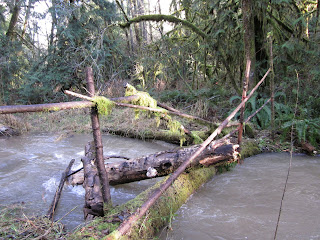
Climbing down and crossing the creek for a different view, we came across Laura's work. A bridge of logs, with railings tied for safety, made access to the county road possible from the forest side. Otherwise one had to take the long way around on a logging road that crossed the only other bridge over the creek for 2 miles. The recent rains had cast up several trees against the frame, but when we inched along the fallen logs, the bridge felt sturdy enough.


We looked back up at the cliff to see if Laura and Jack's camp might be visible from this direction. For people living in the woods for 40 years,I'm not sure why I thought it would be so simple, or so obvious. We called and whistled and called again. There was only silence in response.

And then we left. A note attached to the bridge might have been a good idea if we had had a pen, but our pockets were empty. We never did find Laura in person and she missed the dentist appointment at the clinic.

But, after a fashion, we did find Laura. We found her trails and her woods. We smelled the deep richness of the moss and ferns in her coastal rain forest. We saw the sun break through in streaks and hit the forest floor, and we saw the creek as it receded from flood stage. We found her bridge. And the question begs in the end, was she ever really lost, except to us?


Photos: the woods above our farm, down near the Honey Grove creek, and Laura's bridge

All Rights Reserved. Copyright 2011 Scottie Jones

...Click here to read the rest of this post.

Tuesday, January 11, 2011

Mouse traps gone missing


Old farm houses like ours have resident mouse populations. It just comes with the territory. It's probably true that their claim to the property goes back farther than ours in terms of genealogy. So, does this make them super mice or something? I ask this because my mouse traps have been disappearing at an alarming rate. I set them at night and they are gone by morning. Is this some sort of mouse game to drive the farmer's wife crazy so she cuts off their tails with a carving knife? I know the song.

As any good farm wife will tell you, mouse traps are a must in a house like this. Returning to the store on a regular basis to replace them is ridiculous. I am now beginning to understand why the former owner always had her traps tied with pink string to a post or a hook. She must have had the same problem with these super mice and had no interest in driving to town every time she lost a trap.

I suspect, in the pantry, there is a larger rodent at play. The hole in the floor looks big enough for a rat. I shudder to think what that rat is finding so tasty in a pantry that is filled mostly with canning jars and wine bottles. I know from trying to catch the thieves that a rat won't fall for a rat trap once a buddy has been caught, so I am surprised it would fall for a mouse trap. Unless it is careless with a tail or something.

Every now and again, I will find a sprung trap flung far from where I set it. Sometimes there is something in it and other times not. I debate from time to time whether I am being totally inhumane with these traps, but poison seems worse and too dangerous for our other animals. Glue traps just seem cruel. Spring traps when they catch the neck are fast. What to do when it's just a leg that has been caught? I let the animal go because it wasn't its time to die.

Did I mention we have not one but two cats that are supposed to keep the mouse population in order? Bezel is retired, but Bubba is a killer when he isn't playing catch and release in the house. That would be, catch the mouse outside and release it inside. When he's focused, though, there are no second chances. Maybe he could focus a bit more on the trap thieves so I don't have to go back to the store.

Photo: cat toy in the trap (didn't think a dead mouse was a good idea)

All Rights Reserved. Copyright 2011 Scottie Jones

...Click here to read the rest of this post.

Monday, December 27, 2010

When Turkeys Don't Get Eaten on Time


When turkeys are born late in the spring and survive a raccoon attack because they are so small they are still living in the kitchen, there's a good chance they won't be 'ready' for either Thanksgiving or Christmas dinner. What to do? Well, we end up feeding them instead of eating them!

We now have five indeterminate turkeys because they haven't grown old enough to tell for sure whether they are hens or toms. We already have two toms on the farm: Dutch Boy, our white Holland, that is quite the show-off and very friendly in a good turkey sort of way, and Tom, our Heritage Bronze, that with the goose picks horribly on Dutch Boy, having yanked most of his tail feathers at one time or another. We also have three hens, one of which is Rose, a hand-raised bird that is becoming a menace to small children

With five more growing turkeys, and 11 chickens whose yard the turkeys have taken over, we have quite a few birds that are producing nothing during these shortest days of the year. The math doesn't seem quite right with this. Lots of birds; no eggs. Bags of corn; no eggs.

We are egg-less because the chickens don't think winter is a good time to hatch chicks. I would have to agree. But, there is a darker truth than just the eight hours of daylight in December. Many of our chickens are getting on in years which means they are not longer reliable layers. For many, this would signify chicken soup. For our household, it seems to signify retirement.

The problem we are running into now is the thriving turkey situation. We don't have enough strong roosts for the growing birds, or even enough space on the roosts we do have. Luckily, the birds have taken to flying up to the top of the chicken wire roof and hanging around up there for the night.

I think the wild turkey that has adopted our flock showed the birds they could actually fly. She roosts in the Mulberry tree at night and flies down for a breakfast of corn. She's domesticating herself all on her own, but I do hope we don't mess with the wild/domesticated thing too much if she takes a fancy to Dutch Boy.

I've opened the gates to the chicken yard during the day because I just read that turkeys like to eat grass and the chicken yard is getting a bit worn. The turkeys hang in a crowd as they tromp through the winter beds. Unfortunately, the chickens have shown them my flower pots and I have been chasing turkeys out from digging up all my bulbs.

With turkeys everywhere, I have to watch as I back the car from the carport. Some of the dimmer ones will stand at the back looking at their reflection in the paint. I can say that so far, we have never lost a turkey to a car - only a neighbor's dog and a mean raccoon.

Not sure what Easter will bring, but turkey on the table is unlikely. Maybe we will wait and see what nature provides us in the way of fertility and natural turkey parents. If they turn out to do a good job, Thanksgiving may come and go in the most uneventful way - at least for this group!


Photos: (top) Dutch Boy; (bottom) Rose being fed mulberries and spoiled rotten, which has made her a terror in the chicken yard.

All Rights Reserved. Copyright 2010 Scottie Jones

...Click here to read the rest of this post.

Monday, November 29, 2010

The Old Switcheroo


We were very careful this year with our rams and our ewes. Red is related to half our flock, as in paternal relations. It would be no good to breed him to his daughters and granddaughters, especially when our vet-in-training is trying to improve the herd, not create freaks of nature.

But, as the saying goes, "the grass is greener on the other side" and Red and Duke (our other ram) decided, just for an afternoon, to pull a switcheroo and mess with Annie's charting. Really, it didn't seem quite fair since the girl had gone to all the trouble of keeping good records and having a plan.

People in the know (that would be those who have raised or been around sheep) will nod their heads in sympathy and understanding. "That's a ram for you!" "Always messing with the system." "Doesn't follow the rules, only the ewes." "It's all about the ewes." "What a bunch of hussies!" (That last comment would be mine)

We keep our rams in with the girls usually for about two months. At six weeks, we were feeling good about our system. At six weeks and a day, we almost didn't have a system. It was only about four hours that the flock intermingled when the gate popped open. Except it wasn't obvious until feeding time when it seemed there were way too many ewes in Duke's group. At which point it became an overnight slumber party, because I had left the feeding until almost dark and I couldn't tell one ewe from another. No one seemed to mind.

Annie came home late from work. I almost couldn't choke out what had happened over at the barn. No, I couldn't separate them in the dark. No, I wasn't sure how the gate had popped open. No, I had no idea when this had actually happened except sometime before feeding.

The next morning we scanned the crowd. The sheep weren't inclined to gather back in their original groupings. We cut Red out of the flock and shuffled him back into the barn field. A few of the ewes followed him and we had to hope these were the original group because, without getting right on top of them to see their ear tag numbers, we could only tell if they 'sort of' looked like his original harem.

We did the math. Everything lamb born before 4/29/2011 could be predicted. Those born for at least two weeks after were a crap shoot for the 'who's your daddy' prize. Just like last year, we were going to have to look for droopy ears and white and black coloring to tell if the daddy was Duke. Small ears and brown coloring - probably Red.

Our records are better than they ever have been and I suspect that most breeding records have some guesses in them. Sheep can be relentless when they want to get somewhere and fencing and gates are merely an inconvenience that will wear down with time. The baling twine breaks. The fence wire pops. And, soon enough, there is the mingling of sheep in a late season romp. All in the name of the lambs.


Photos:(top) Piglet (couldn't find a duo photo with Duke) and Red in their 10-month-a-year retirement pasture; (bottom) eager young rams (before they were sent off to graze the power lines in WA)

All Rights Reserved. Copyright 2010 Scottie Jones

...Click here to read the rest of this post.

Wednesday, November 10, 2010

Rural Roof Repair


It has taken seven years, but we have joined the ranks of rural roof repair. We have resorted to a tarp. I did, however, put my boot down at a blue one.

We have had a leak in one of the upstairs bathrooms for a while now. Maybe five years. It's not a problem unless it's raining. Let's just say that for the four months of summer, when we are relatively rain-free, we are good to go and the buckets and pans are stashed under the bathroom sink.

With the first rains of fall, I am back to digging around under the sink for my buckets.

It's not that we have just left the roof to leak on its own. Each summer we climb up, way higher than I like to be, to add a bit more tar, a bit more glue, a bit more of anything we think might help. Is it a leak from the skylight or is it the actual asphalt tiles? Is it from the improperly set flashing or something else?

Short of taking all the roofing off, which could reveal far more of a horror than we are yet ready to tackle, tarps seemed the next best solution because, as I may have forgotten to mention, this is a bathroom our guests use, and that would also be my mother.

The leak(s) run right through the middle of the smallish room onto a carpet that begins to get soggy and then stained. We set the buckets and pans down for specific drips, but this means they have to be moved and then replaced if you happen to want to close the bathroom door! There's an art to dodging the dishes. It's not something you want to have to do in the dark, even with a night-light.

What I can say about tarps is that they work for a while. We have taken to tacking them down with wood strips because the coast winds come ripping up our valley in winter and, well, rip the tarp with ripping winds. Hence maybe the saying? We realize this is a temporary solution, but are lulled each time we tack down a new tarp.

Our neighbor thinks he has our solution and is willing to give it a shot next summer when the rain has stopped. We'll try a 'real' roofing trick: tar paper. Since the roof is mostly hidden from view, I don't think anyone will notice. It took us three years just to realize the roof wasn't even shake like the rest!

I'm willing to go along with this scheme, as long as no one insists I climb up to confer (although it is a fabulous view of the farm!). When the rains start again, I'm good if I can look up at the ceiling and only see stains from our tarp and glue years.

All Rights Reserved. Copyright 2011 Scottie Jones

...Click here to read the rest of this post.

Sunday, October 24, 2010

Peeps in Trouble


You will remember that Peeps is our third rooster. Third as in pecking order third. He's a great bird, but life has become cruel in the chicken yard and he's hiding more and more in the chicken coop. Something is wrong. Peeps is in trouble.

I noticed he was starting to languish. I counted on my fingers. How old was Peeps? I think at least 6, which is old for a chicken. Was he dying of old age or was he ill? He let me pick him up, which was a bad sign all unto itself. He felt light and bony. I brought him into the house and placed him in front of the wood stove. Maybe a night in the house would do him good.

Crammed into the chick cage, Peeps endured the cat looking at him eye to eye. His long tail had to be held down to close the door to the cage. The bird stood and looked at me as I filled a bowl with grain and another with water. It was a vacant stare. Was life really worth this. A cat on the outside and he on the inside?

The next day he ate a little food, but mostly slept with his head under his wing. It didn't look good. He ate more and then, all of a sudden, he was ravenous. Peeps was beginning to look too big for the cage and I decided he was. I let him out on the lawn with the peacock. It was time for roosting and a return to the cage. We couldn't find him. Had he wandered off to die. Just great!

As we walked back in through the mud room where the door had been left ajar, Peeps was crouched near the front door. Time to come in. One more night in the safety of the house. Even with a cat at eye level.

The next morning he ate a breakfast of corn and returned to the chicken yard. I think the problem all along was starvation. In a yard full of chickens, Peeps had not held his own when it came to feeding time. He now gets an extra handful when I catch him on the outskirts. However, he had devised his own plan for eating. When I take the top off the feed bin and scoop out a bucket to scatter to the hens, he will jump into the can and eat his fill until I return and shoo him out. If it works for him, it works for me. Heck, this winter he might even be able to take care of the wayward mouse or two that inevitably finds its way into the bin and tries to run up my arm as I dip for the grain. If ever I have wanted to yell "Eeek", it would be then.


Photos: (top) Peeps squished into the chick cage for a night or two; (bottom) all better and looking the pretty boy in the sunlight.

All Rights Reserved. Copyright 2010 Scottie Jones

...Click here to read the rest of this post.

Sunday, October 03, 2010

Adios Chaco


It was a fall day today of no particular note. The golden leaves of the alder trees dropped at the hint of wind, onto ground covered with brilliantly green fall grass. The sky was blue, yet clouds edged in with the afternoon, adding a hint of autumn to a weekend that boasted t-shirts.

Despite all this normality, it was not a normal day for the farm. Today was Chaco's day to die. A pre-planned day. Not pre-ordained, but chosen from so many other days. Chosen in the middle of the night because this is not a decision made in day. A slow decision that has been a long time coming. And then it was made and here we are.

How does a horse survive when he can no longer see where he is going? How many fences will he have to run in to, with cuts on his nose and legs to prove? Will a raging creek in winter sweep him off his feet for the last time because he doesn't trust knowing where the bridge drops off at the edge? In the end, what does our love count for if we can't be responsible to end his life well, after so many years of cantering on the correct lead, learning to jump as a team, riding trails?

For Chaco, it was a normal day. He ate grass. He waded across the summer creek. He was surrounded by the baaing of sheep and the companionship of the other horses. Sure, we paid him extra attention in the past few days. He was brushed and fed treats. His mane and tail were combed. And he was brushed again.

But for the farm, this day had been hanging around for a week. Time to do something, anything, that would make a memory or a kindness to add to the memories and kindnesses that have followed us for the past 14 years. So, we took photos and even a last ride around the property. And then today we took some family photos with Chaco, the kind that sport all the kids, except here we had the donkey and the other horses butting into the picture too. And it was a beautiful day. And we were all very much aware of our personal sorrow for a horse we had come to love over time and who would, in a short while, be gone from our world.

They tell me it was quick and he didn't feel a thing. The horses in the barn spooked at the shot and then went back to eating their hay. The sheep lifted their heads from the pasture. I looked out through a screen of trees where I had last seen the whiteness of Chaco's coat as he stood in the sun. He was gone. And the tractor quickly filled the hole with dirt and the field took on the surreal look of peacefulness and quiet. But for the fragrance of fresh dirt, I could have closed my eyes and thought I imagined it all.

Adios Chaco

"...may you run joyfully with the big herd in the sky, may you clear every jump you attempt, may the fields be bountiful and filled with your favorite grass, may there always be a big mud puddle to roll in, and may there always be someone there to brush you while saying sweet nothings in your ear. I (We) will truly miss you Spuds McKenzie (Chaco)."
- Facebook post by Emery Jones 10/3/10


Photos:(top) Chaco, alert at the sound of our approach; (middle) Chaco's family; (bottom) flowers at his grave, and the master of his stall. All taken the weekend of 10/3/10.

All Rights Reserved. Copyright 2010 Scottie Jones

...Click here to read the rest of this post.

Wednesday, September 22, 2010

Black Hay


There's nothing better than smelling fresh cut hay and imagining a barn full of it. There is nothing worse than days of rain falling on fresh cut hay and turning it black with mold. It's enough to make you cry. Your neighbor too. She could smell that hay all the way up at her barn. I think I hear her crying now.

We've only tried for a second cutting of hay once before and, while it was hard to dry with the heavy dew of autumn, we got it in and were in love with our hay well into the winter. This year seemed auspicious. The year was late for hay but all the forecasters promised a late, dry fall, because we were owed a late, dry fall. What did they know?

Farmer Jones spent the summer irrigating day in and day out. When he couldn't do it he trained our buffed up high school neighbor to move the pipe and set the valves. The hay looked good but not that high when our farmer neighbor with the haying equipment stopped by. Did we want to cut yet? Was he going to? No, he wanted to wait a little for a taller grass. So did we. The forecasters had said it was going to be a late, dry fall.

Okay, so it wasn't. The first cut of hay is now all we have going into winter. I look at it this way. The horses and sheep don't know what they are missing because nothing was ever brought in. I hope that the wonderful hay sitting on the ground re-seeds the soil and we get another chance at two cuts next summer. Of course, it means more irrigation and no promises.

Next summer we won't be greedy. We will cut when the sky is still blue and the days are lengthening but not stormy. Unless, of course, the forecasters tell us it will be a late,dry fall. And we forget what we learned. And we smell that wonderful green hay and imagine what it would be like if it were just a few inches taller.

Photo: Irrigating the hay field one 20' pipe at a time. There are 16 to reach across the entire 8 acres. Farmer Jones moves them once a day.

All Rights Reserved. Copyright 2010 Scottie Jones

...Click here to read the rest of this post.

Monday, September 13, 2010

Tomatoes 1 Grapes 0


Every farmer I know is complaining about their gardens and fields this year. The long, cool, wet summer has stunted the growth of many plants, marked others with brown spots, and left the rest unripened. I understand the good year - bad year cycle but I am going into the second year with few apples and plums and absolutely no pears.

If you like green beans, this is your year. Every cool veggie is happy. It's way past time for grapes but they still hang green on the vine. It's time for tomatoes but they hang green even in the greenhouse. The ripening is so delayed that school has started and the canning has barely begun. This means everything is going to happen at once, I just know it!

I suppose it sounds like whining, but we have coined a phrase out here. It's called the 'burden of abundance'. I know it sounds absolutely horrible to feel overwhelmed with too much food, but there are times when I can't even see my counter space because it is loaded with perishable time bombs. Too many cucumbers all at once either mean hours canning or the chickens get the rotten ones. It's the same for the tomatoes when they finally ripen. Ah, but there is nothing better than a red, ripe tomato with a little olive oil and fresh basil. Okay, I can't wait for it, but I also know the canning process takes time and care.

In the end, because of the vagaries of the weather this summer, we will spend a winter eating green beans, some peas, chiles, and tomato sauce. How bad can that be? My freezer also has 2 lambs since we are still trying to decide if ram lambs taste any different from ewe lambs. I think they may be tougher but that's about it. The beef is all but gone, as is the pork. I think I spied some elk burgers and maybe a fish fillet or two. We have lots of potatoes as long as we can keep them from freezing this winter. Our onions are a bit problematic since I don't think we have totally figured out how to store them. The kiwis will be large, but not plentiful. Except, how many kiwis can you eat anyway. The figs have been made into jam.

Okay, so I guess the harvest hasn't been and won't be a total loss. With the grapes ripening late, I doubt the yellow jackets will be too bad. I wonder what the deer and bear will do without their fall fruit. Well, I know the deer are eating my flowers all around the house and grazing on the lawn at night, so that's their answer. Haven't seen any bears close by (or at all), so I won't worry there.

Tomato sauce will go well for the winter months and who likes picking the stems out of all those grapes for raisins anyway?


Photos: (top) greenhouse tomatoes on their way to ripening; (bottom) a one-day harvest, not counting what is sitting in the buckets all around the butcher block!

All Rights Reserved. Copyright 2010 Scottie Jones

...Click here to read the rest of this post.

Monday, August 23, 2010

Tater the Terrible


Tater has ramped up his trouble-making. I used to compare him to a teenager. I would like to revise this to a two-year-old. You know, the two-year-old that likes to open every kitchen cabinet he can find and pull all the pots out. How about the cabinets that have the cleaning supplies?

Today he figured out how to open a door into the barn that uses an old style latch with a weight. How did he figure this out? At first, per usual, I thought I must have left the door unlatched after feeding. The donkey is quite adept at taking advantage of this particular door. It must have been the donkey. I latched the door purposefully the next evening. And, the animals were in the barn again in the morning.

Our guests find this behavior particularly funny and endearing. Tater will usually be back in the loafing shed when we turn up for morning rounds. Moralecia will be looking for a way out and the donkey will be skittering along the wood floors of the barn attempting to push past me to the door.

I'm a little smarter with the horses these days when it comes to reducing opportunities for chaos. I only drop a bale of hay at a time, so the most the animals can redistribute is this and maybe some loose straw. The trash can is always up-ended and horse blankets, stools, and brush buckets strewn about, but the biggest clean-up is the horse poop. Gives everyone a reason to try their hand at the push broom. For now I have rigged a chain through the door so the horse can't get in. Of course, we can't get out either.

Tater the Terrible was not to be outdone. He took on the feed stall next, a door that had never been tested as Tater-proof, but why? It was locked with a wire twist. We were lucky at first because the grain was low in the bins. I would retwist the wire. The horse would hoist himself up a three foot step, knocking over stored jump rails and standards, and plop (and I do mean plop) himself in the middle to the grain bins. By the time I finally came up with a solution to this behavior, he had flattened several metal trash can lids and eaten every ounce of food not run off by the rats and the mice.

Because my brain is only slightly larger than his, it took me several attempts to find a hook big enough and inflexible enough that Tater finally gave up his drive to drive me nuts. It's hard to be mad at a horse with such intent and big, brown eyes. I'm just glad neither he nor the other equines ate so much they colicked. There was that one morning when they all bee-lined for the water because they ate their fill of salt. I can't even conceive what will be next; however, my two year old grandson might have an idea.

Photo: Tater not looking so terrible here. Bored, maybe. "Get that lady to let go of me!"

All Rights Reserved. Copyright 2010 Scottie Jones

...Click here to read the rest of this post.

Friday, August 06, 2010

Chicken Prison


They say chickens have a brain the size of a pea. So then why do they look so guilty when I catch them on the outside of the chicken yard. Could it be because they have dug up the new cucumber plants for the third time which means we won't be growing any cucumbers this summer?

I like free-range chickens, really I do. They eat slugs and all sorts of bugs. They fertilize as they move through the bushes and flower beds. It's just that small, new growth doesn't have a chance with the scratch, scratch, scratch of those busy feet. It's amazing what devastation one to two loose chickens can cause in a short amount of time.

Mound saw dust around the base of the blueberry bushes and a loose chicken can spread it across the grass before you even know the bird is out of the coop. Pile up leaves as mulch for the Cascade berries to keep down the grass and weeds and it ends up pushed around in clumps with bare spots of earth showing through.

Leave the door to the greenhouse open so the temperatures won't climb to 120 degrees and this is an open invitation for the birds to scratch in any disturbed area for worms. We plant our tomatoes, chiles, cucumbers, dill, basil, and eggplant straight into the ground, providing plenty of disturbed dirt for a good scratch, scratch, scratch.


What made farmer Jones the maddest this summer, however, was the ruthless pursuit of his baby potted veggies on top of the planting table. Nurtured from seed, it's a hard thing to see dirt dug from the middle of carefully tended six-packs and wilted plants dying on the table, roots bare and dry. So, he thought he would try to hide his plant starts in the garden, with its 8 foot fence and lush growth from cool weather plants like lettuce, peas, and broccoli.

Too bad the garden actually shares 100 feet of fence with the chicken yard because somehow Boston, our hand-raised white chicken, and two smaller Red Caps figured out how to squeeze through the woven wire despite my attempts to cover more and more of the fencing with a double layer of chicken wire.

In the end, the questions is this. Why did it take until the last cucumber shoots were scratched out, along with many of the new flowers, to consider chicken jail for the worst offenders? While we offer our chickens a Hilton Resort in terms of their yard space, we also have smaller containment areas usually reserved for introducing chicks and new animals to the flock. It wasn't that hard a leap to make, but it took threats ranging from shooting to eating to provide the ultimate incentive.

The morning after, there was peace in the yard, peace in the garden, and three chickens staring at the door every time it opened for water and food. Do I feel badly? Absolutely not. Well, for the chickens anyway. As for the farmers, they just need to be smarter than a neural tube and not nearly so soft hearted when it comes to their feathered friends.


Photos: (top) Peeps, (middle) Boston scratching in a window box, (bottom) free-range chickens in early spring before they can do a lot of damage to the flower beds

All Rights Reserved. Copyright 2010 Scottie Jones

...Click here to read the rest of this post.